
Dead battery? Hot cables? We can help.
If your car will not start, your battery keeps dying, or jumper cables are overheating, call Batteries Inc before guessing. We can help you match the right replacement battery and avoid costly mistakes.
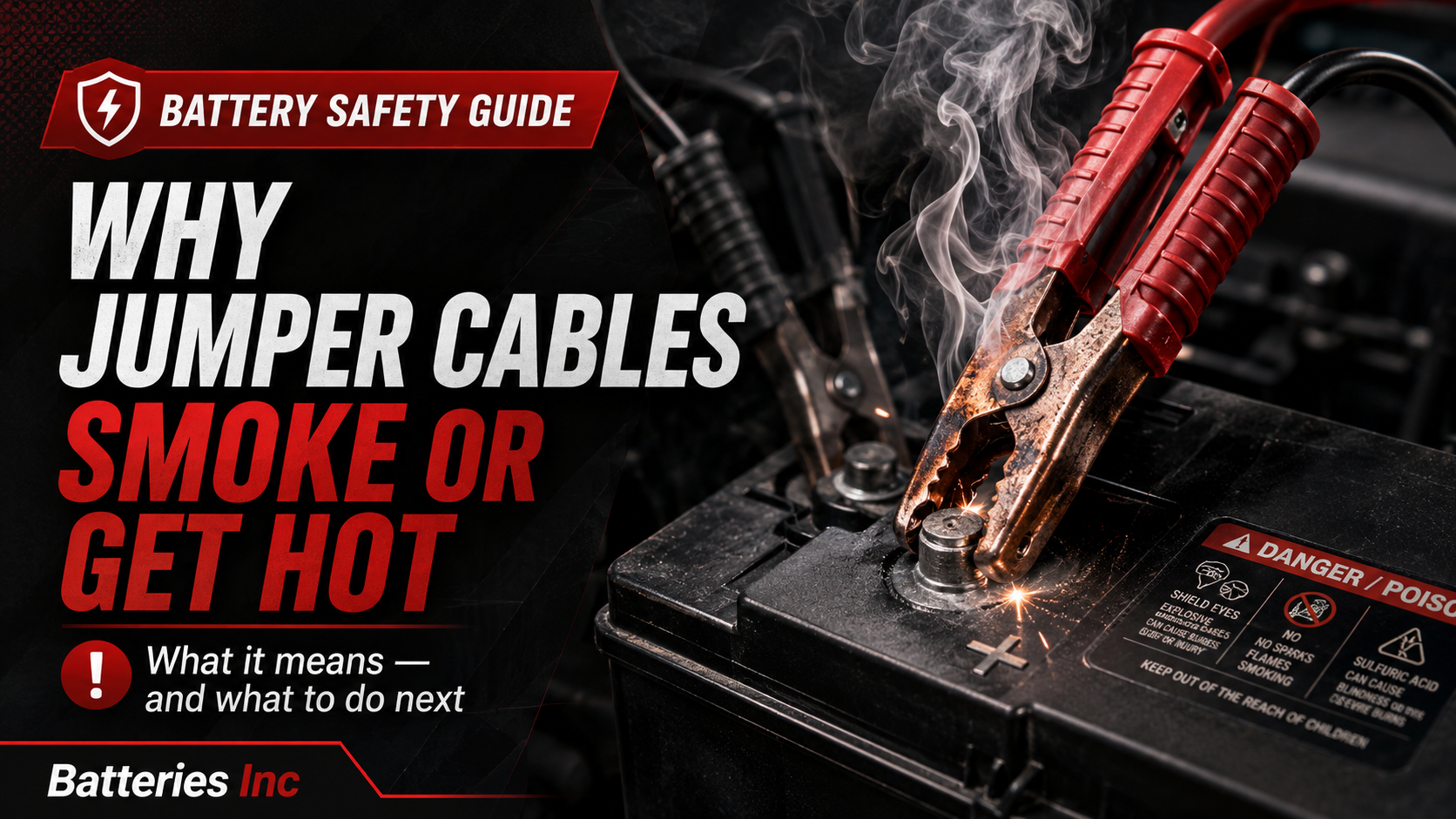
Safety first: If jumper cables begin smoking, melting, sparking heavily, or become too hot to touch, stop the jump-start attempt immediately. Let the cables cool, keep the clamps separated, and do not keep cranking the engine.
A dead car battery is frustrating, especially when you are heading to work, picking up family, or managing a vehicle for your business. Jumper cables can help in the right situation, but they are only a temporary solution. If they start smoking or getting extremely hot, your vehicle is telling you something is seriously wrong.
Hot cables often point to excessive current flow, poor connections, or a damaged battery. In many cases, the problem is not just a dead battery. It may be the wrong cable size, reversed polarity, corroded terminals, a shorted battery, or an electrical issue that needs to be checked before another start attempt.
What Smoking Jumper Cables Usually Mean
Jumper cables overheat when too much electrical current tries to pass through them or when resistance builds at the connection points. That resistance can come from loose clamps, corrosion, thin cable wire, exposed wiring, reversed connections, or a battery with internal damage.
A little warmth after a difficult start can happen with some lower-quality jumper cables. Smoke is different. Smoke means heat has reached a level where insulation, plastic, rubber, corrosion, or debris may be burning. That is the signal to stop.
Connecting positive to negative by mistake creates a dangerous reverse-current situation that can overheat cables, blow fuses, and damage sensitive electronics.
Light-gauge jumper cables may not handle the current needed for trucks, SUVs, commercial vehicles, or deeply drained batteries.
A swollen, cracked, internally shorted, leaking, or frozen battery can draw excessive current and make any jump-start unsafe.
Stop Immediately If You Notice These Warning Signs
- Smoke visibly rising from the cables, clamps, or battery area.
- Cables becoming too hot to touch.
- Melting plastic or rubber insulation.
- A sharp burning smell near the cables or battery.
- Heavy sparking when connecting the clamps.
- A swollen, cracked, leaking, or frozen battery case.
- A rotten-egg odor near the battery.
- Repeated failed start attempts after the cables are connected.
Ignoring these signs can turn a simple battery issue into wiring, alternator, fuse, or control-module damage. Modern vehicles use sensitive electronics, so forcing a jump-start when something is clearly wrong is not worth the risk.
The Most Common Causes of Hot or Smoking Jumper Cables
1. The cables are connected backwards
Red should connect to positive, and black should connect to negative or an approved ground point. Mixing them up can create a short circuit through the jumper cables, producing extreme heat, melted insulation, blown fuses, or damaged electrical components.
Always check the battery terminals before connecting anything. The positive terminal is usually marked with a plus sign and may have a red cover. The negative terminal is usually marked with a minus sign. Some vehicles also use remote jump posts under the hood instead of direct battery access.
2. The jumper cables are too small for the job
Many budget jumper cables are thin and are not built for high current demand. They may be acceptable for a small vehicle with a mildly weak battery, but they can struggle with trucks, SUVs, diesel engines, commercial vehicles, and batteries that are deeply discharged.
When a cable is too small, resistance increases. Resistance creates heat. Heat can soften insulation, damage clamps, and eventually create smoke. If your cables feel flimsy or get hot within seconds, they may not be the right tool for the job.
3. The clamps are loose, dirty, or corroded
Rusty clamps and corroded battery terminals can prevent clean current flow. A poor connection works like a bottleneck. The vehicle demands current, but the connection cannot transfer it efficiently, so heat builds at the weakest point.
This is why smoke or sparking often starts near the clamp instead of in the middle of the cable. If the clamps are loose, rusted, or barely gripping the terminals, stop and inspect the connection before trying again.
4. The battery is beyond saving
A battery that is swollen, leaking, cracked, frozen, or internally shorted should not be jump-started. A jump-start is meant to help a discharged battery recover enough power to start the engine. It is not meant to revive a physically damaged battery.
If the battery case looks distorted, fluid is visible, corrosion is severe, or the battery has been dead for a long time, testing or replacement is the smarter path.
5. The vehicle has another electrical problem
Sometimes the battery is only part of the issue. A failing starter, charging-system problem, bad alternator, loose battery cable, parasitic draw, or short circuit can make a jump-start difficult or unsafe.
If a new or fully charged battery keeps dying, the vehicle should be checked. Replacing the battery may solve the symptom temporarily, but it will not fix a charging issue or electrical drain.
What To Do If Your Jumper Cables Start Smoking
- Stop cranking the engine. Do not attempt to restart while cables are hot or smoking.
- Turn off both vehicles. Shut off lights, radio, air conditioning, and other accessories.
- Allow the cables to cool. Do not touch hot or melting insulation with bare hands.
- Disconnect carefully. Keep the clamps away from each other and away from random metal surfaces.
- Inspect the cables and battery. Look for melted insulation, damaged clamps, battery cracks, swelling, corrosion, or leaks.
- Do not reuse damaged cables. If the insulation melted or the clamps overheated, replace the cables.
- Get the battery evaluated. Smoking cables suggest the battery or electrical system may not be safe for another jump attempt.
If you are in Orlando, Oviedo, or the surrounding Central Florida area and are unsure what battery you need, Batteries Inc can help match the correct battery type, group size, terminal layout, and application for your car, truck, SUV, marine battery, RV, golf cart, powersport vehicle, lawn equipment, or commercial equipment.
Safer Jump-Start Procedure
Always check your vehicle owner’s manual first. Some vehicles have remote jump posts, special battery locations, or manufacturer-specific instructions that should be followed.
A common safe connection order is:
- Connect one red clamp to the positive terminal of the dead battery.
- Connect the other red clamp to the positive terminal of the good battery.
- Connect one black clamp to the negative terminal of the good battery.
- Connect the final black clamp to a clean, unpainted metal ground on the disabled vehicle, away from the battery when possible.
- Start the donor vehicle, wait briefly, then attempt to start the disabled vehicle.
- Remove the cables in reverse order without letting the clamps touch each other.
When To Replace the Battery Instead of Jump-Starting
- Your vehicle needs multiple jump-starts per week.
- The battery is older and the vehicle cranks slowly.
- Visible corrosion, swelling, cracking, or leaking is present.
- Jumper cables smoke or get extremely hot during a jump attempt.
- The vehicle starts with a jump but dies again later.
- You are unsure if the current battery is the correct size or rating.
Guessing can cost more than checking. The right battery matters because vehicles need the correct group size, terminal layout, cold cranking amps, reserve capacity, and battery type. Installing the wrong battery can cause fitment issues, poor performance, short battery life, and avoidable frustration.
At Batteries Inc, we help you pick the right replacement for your actual application, not just the closest battery on the shelf. That includes automotive batteries, marine batteries, RV batteries, golf cart batteries, powersport batteries, lawn tractor batteries, commercial batteries, chargers, cables, and accessories.
Hot jumper cables? Dead battery? Let’s fix it right.
Do not risk damaging your vehicle with repeated failed jump-start attempts. Our team can help match the correct battery for your vehicle, equipment, or application. Call us or visit our stores in Orlando or Oviedo.
Frequently Asked Questions
Is it normal for jumper cables to get warm?
Mild warmth can happen during a difficult start, especially with thinner cables. However, cables should not become too hot to hold, smoke, melt, or smell like burning plastic. If that happens, stop immediately.
Why are my jumper cables smoking but the car will not start?
Smoking cables usually indicate excessive resistance, reversed polarity, poor clamp contact, undersized cables, or a battery/electrical problem. The current cannot flow properly, so heat builds at the weakest point.
Can damaged jumper cables hurt my vehicle’s electronics?
Yes. Reversed connections, intermittent contact, or melted cables can cause voltage problems that may damage fuses, the alternator, or sensitive electronic control modules.
Should I jump-start a battery that is swollen or leaking?
No. A swollen, leaking, cracked, frozen, or heavily damaged battery should not be jump-started. Replace or professionally evaluate the battery instead.
How can Batteries Inc help me choose the right battery?
Tell us the year, make, model, and engine when available. We can help match the correct group size, terminal position, cold cranking amps, reserve capacity, and battery chemistry for your vehicle or equipment.
Visit Batteries Inc — Orlando & Oviedo
Need help? Call us or stop by one of our Central Florida battery stores. Visit Batteries Inc Orlando at 4855 Distribution Ct. #7, Orlando, FL 32822, or call (407) 281-1810. You can also visit Batteries Inc Oviedo at 2785 Wrights Rd Suite B1129, Oviedo, FL 32765, or call (407) 809-5636. Whether your jumper cables smoked, your battery keeps dying, or you simply want a reliable replacement, our team can help you drive away with the correct battery and more confidence.
We also carry marine, golf cart, RV, powersport, lawn tractor, commercial, and specialty batteries for customers throughout Orlando, Oviedo, and Central Florida.
Safety note: Always follow your vehicle owner’s manual and battery manufacturer guidelines. If a battery is cracked, leaking, swollen, frozen, sparking, or producing a strong odor, do not attempt to jump-start it. Get professional help.