
Is Your Car Battery Healthy? Check Your Voltage Before It Leaves You Stranded
Most car batteries do not fail without warning. They weaken first. The problem is that most drivers do not notice the signs until the car will not start and they are already late, stuck, or calling for help.
Battery voltage is one of the fastest ways to spot trouble early, but only if you know what the numbers mean and what they do not tell you. A battery can look “fine” on a quick voltage check and still be on its way out.
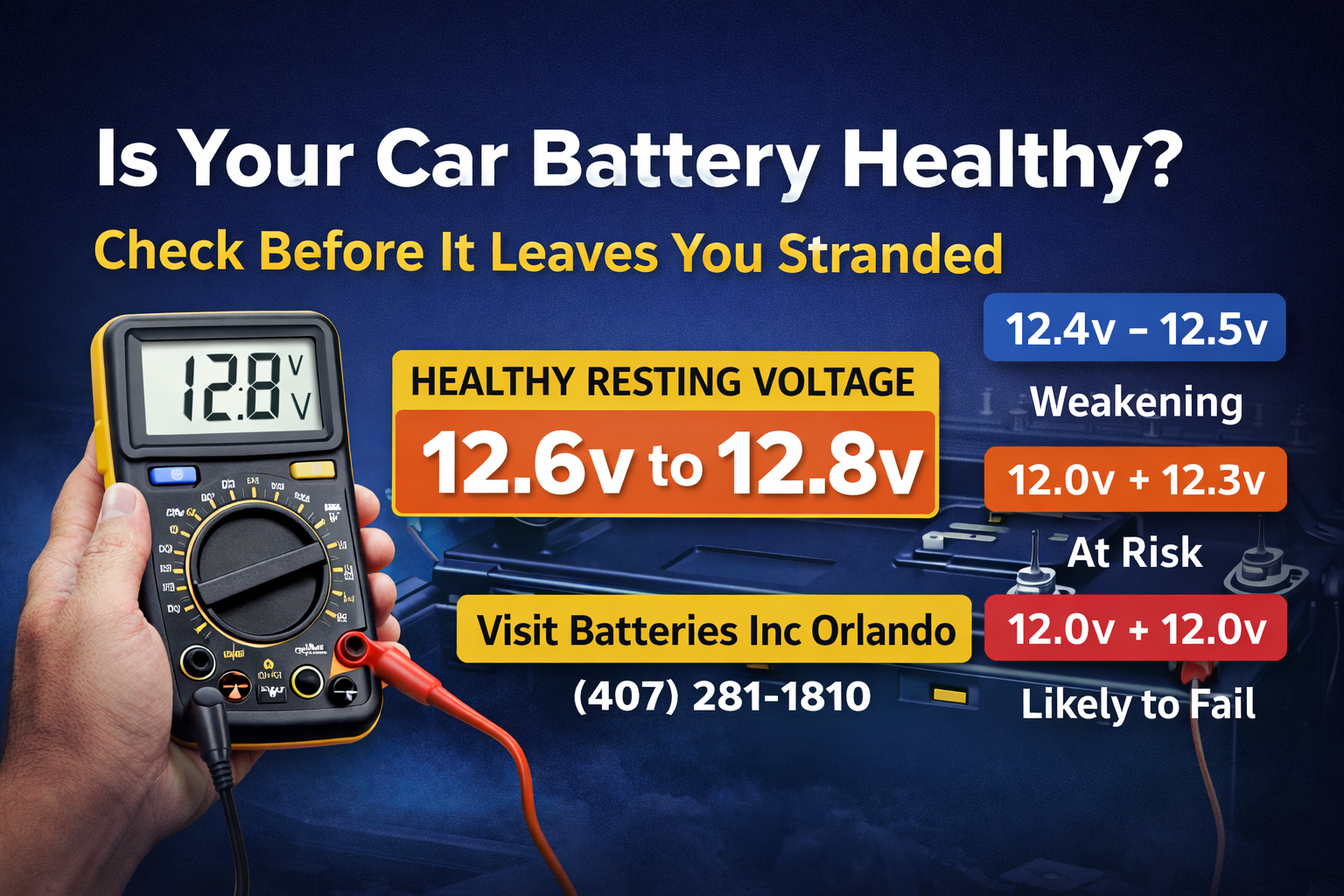
Quick answer: A healthy 12V car battery will usually read around 12.6 to 12.8 volts with the engine off after resting, and many vehicles will show around 14.2 to 14.5 volts with the engine running because the alternator is charging the battery.
But voltage alone is not a complete health test. If you want a real answer, get the battery checked properly at Batteries Inc Orlando.
If you are searching for this topic, there is a good chance you already have a reason. Maybe the car has been cranking slowly. Maybe it needed a jump. Maybe the lights looked dim. Maybe you checked the battery with a meter and got a number that did not mean much to you. That is exactly why this topic matters: a battery problem does not need to be fully dead to become a real problem. By the time it fails completely, the inconvenience has already arrived.
The goal is not just to know whether the battery has any life left right this second. The goal is to know whether it is still dependable. A battery that barely starts the car today is not a healthy battery. It is a battery making decisions for you. This guide will walk through what healthy voltage looks like, what low numbers suggest, why a “good” reading can still mislead you, and when it makes more sense to stop guessing and get a proper battery test from a local battery shop that does this every day.
What Voltage Should a Healthy Car Battery Read?
Let’s start with the question most people ask first. What should a healthy battery actually read? For a typical 12V automotive battery, a healthy fully charged battery at rest usually lands around 12.6 to 12.8 volts. That is the resting voltage, meaning the engine is off and the battery has had time to settle instead of being measured right after starting, charging, or driving.
That number matters because it gives you a fast snapshot of battery state of charge. Interstate notes that a fully charged 12V battery produces at least 12.66 volts, which lines up with the practical “healthy battery” range that shops and technicians commonly use. But it is important to treat that reading as a first step, not the whole diagnosis.
Easy voltage guide for most 12V car batteries:
- 12.6V to 12.8V: usually healthy and fully charged
- 12.4V to 12.5V: somewhat discharged or beginning to weaken
- 12.2V to 12.3V: noticeably low and worth checking soon
- 12.0V or lower: deeply discharged or at much higher risk of failure
If your battery is consistently reading below about 12.4 volts when it has been sitting, that is your signal to pay attention. It does not automatically mean replacement, but it does mean the battery is no longer giving you the kind of healthy margin you want from something responsible for starting your vehicle.
What Should Battery Voltage Be With the Car Running?
Once the engine is running, you are no longer just reading the battery. You are seeing the charging system at work. In many vehicles, the voltage at the battery should rise to around 14.2 to 14.5 volts because the alternator is actively charging it. ODYSSEY states that if the battery is being used in a starting application, the alternator should provide between 14.2 and 14.5 volts at the battery terminals.
Why does that matter? Because some “battery problems” are actually charging problems. If the battery keeps going weak, but the charging system is underperforming, replacing the battery may only give you a temporary fix. On the other side, overcharging can also shorten battery life. That is why smart diagnosis is not just “battery good or bad.” It is also, “is the vehicle charging the battery correctly?”
What running voltage can suggest:
- Roughly 14.2V to 14.5V: many charging systems are operating normally
- Consistently low while running: possible undercharging or alternator-related issue
- Consistently high while running: possible overcharging that can damage battery life
Can a Car Battery Show Good Voltage and Still Be Bad?
Yes, and this is one of the most important things to understand in the entire article. A battery can show what looks like healthy voltage and still be bad. Midtronics specifically warns that voltage alone cannot be used to diagnose a battery, because the battery voltage might appear completely normal while the battery is bad.
This happens because voltage is only part of the picture. A battery may still have enough surface charge to show a decent number on a meter, but it may no longer have the cranking performance or internal health needed to be reliable under real starting demand. Midtronics also notes that measured available cranking performance matters, and that low performance is a warning sign even if voltage looks good.
Simple truth: a nice-looking voltage number can still hide a weak battery. That is why real testing beats guessing every time.
This is also why people get blindsided. They test the battery, see a “normal” number, and assume the battery is healthy. Then the next cold morning, the next long sit, or the next hard start exposes the real problem. If the car has already been acting weak, inconsistent, or suspicious, do not let one number talk you out of getting it properly checked.
Good Voltage Does Not Always Mean Good Battery
If your car is slow to crank, needed a jump, or just feels inconsistent, get the battery checked before it leaves you stranded.
What Voltage Is Too Low for a Car Battery?
“Too low” depends on what you are trying to do. A battery can still have enough power to run lights or accessories and still not be strong enough to start the engine confidently. For most drivers, the practical line is simple: if the battery is resting below about 12.4 volts, it deserves attention. Around 12.2 volts is meaningfully low. Around 12.0 volts or lower pushes you into territory where starting issues become much more likely.
The real trap is waiting until the battery is dramatically dead before doing anything. By then, the inconvenience has already shown up. A lower-than-normal resting voltage is not a reason to panic, but it is a good reason to stop pretending the battery is definitely fine.
How Do You Know if It Is the Battery or the Alternator?
This is one of the most valuable PAA questions because replacing the battery will not solve a charging-system problem. If the battery goes weak repeatedly, the obvious suspect is the battery itself, but not always. Sometimes the alternator is not replenishing the battery correctly. Sometimes the issue is electrical draw. Sometimes the battery is weak and the charging system is not helping.
A few clues can help point you in the right direction:
- If the resting voltage is low and the battery is older, the battery itself may be weakening.
- If the battery keeps going down even after normal driving, the charging system may not be doing its job.
- If the engine is running and voltage is clearly outside a normal charging range, the alternator or regulator deserves attention.
- If the battery warning light appears, that is a strong sign not to assume it is “just the battery.”
The best answer is not to guess. Test both the battery and the charging system together. That is how you avoid wasting money on the wrong fix and dealing with the same problem again next week.
What Are the Signs of a Weak Battery Before It Dies?
One reason dead batteries feel like they “came out of nowhere” is that people ignore the earlier signs. Midtronics points to several signs that a battery is failing before it dies, and they line up with what drivers usually notice first: inconsistent starts, weak performance, and symptoms that feel small until they are not.
Common warning signs of a weak battery:
- Slow or lazy cranking when starting
- Needing a jump start
- Inconsistent starting from one day to the next
- Dim lights or odd electrical behavior
- A battery that seems to lose strength after the car sits
The main thing to understand is that a weak battery is not the same as a healthy one that just happens to start today. If it is acting questionable, that question itself is the problem. You want reliability, not “maybe.”
How Long Should a Car Battery Last?
Most batteries land in a rough lifespan range of about 3 to 5 years, but real-world life depends heavily on use, charging health, time sitting, and overall vehicle demand. Interstate notes similar broad lifespan guidance. That is why age is useful context but not the only thing that matters.
Short trips can be rough on battery life because the alternator may not have enough time to fully recover what the start pulled out. Long periods of sitting are rough too. Repeated deep discharges, chronic undercharging, and electrical demands from modern vehicles all shorten the margin a battery has left.
The practical takeaway is simple: if the battery is already a few years old and the car is showing symptoms, do not wait for a total failure before getting answers.
Want a Straight Answer Instead of a Guess?
Bring it to Batteries Inc Orlando and get the battery checked before you lose time to a no-start problem.
How Often Should You Test a Car Battery?
If the battery has never given you any trouble, it is easy to forget about it. But testing it before failure is one of the easiest ways to avoid surprise breakdowns. A good rule is to test it at least once a year, and sooner if the battery is older, the vehicle has sat a lot, or you have noticed slow starts, dim lights, or a recent need for a jump.
You should also have it checked after a deep discharge, after the battery warning light appears, or any time the car behaves differently than normal when starting. Batteries rarely get better by being ignored.
Why Batteries Inc Orlando Is the Right Next Step
This article gives you the framework. It helps you understand what healthy voltage usually looks like, what low readings suggest, and why one voltage number is not the same thing as a clean bill of health. But the fastest way to turn all of that into certainty is still a proper battery check.
Batteries Inc Orlando positions free diagnostic testing as part of its customer process, including for suspected defective batteries under warranty, and the site repeatedly directs customers to call or come in for help. That fits this article perfectly because the conversion should be simple: if you are wondering whether the battery is healthy, that is enough reason to get it checked.
Do Not Let a Weak Battery Make the Decision for You
If you are wondering whether your battery is healthy, that is already a good reason to get it checked.
Find out now, not when the car will not start.
Batteries Inc Orlando