
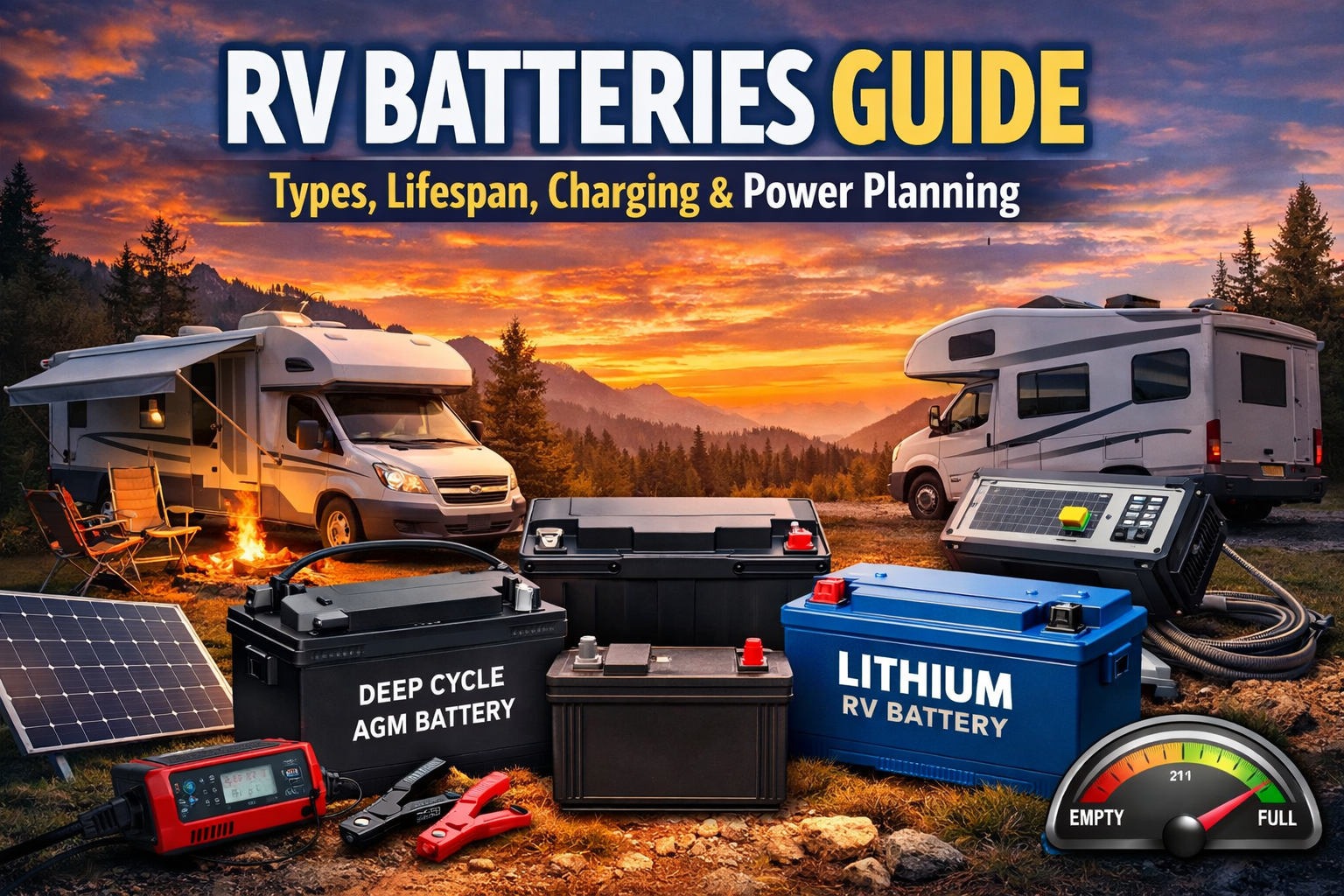
If you rely on your RV or motorhome for road trips, weekend camping, or full-time travel, your battery bank is the foundation of comfort and reliability. This guide explains RV battery types, sizing, charging, storage, and troubleshooting in plain language—so you can build a power system that matches your travel style.
RV Batteries vs. Car Batteries: The Difference That Saves You Money
A common mistake is assuming any 12-volt battery will behave the same. Automotive starting batteries are built for short bursts of high current to start an engine. RV "house" batteries are designed for steady energy delivery over hours—running lights, fans, control boards, water pumps, and inverters.
If a starting battery is used as a deep-cycle battery, it can fail quickly because its internal construction is not optimized for repeated deep discharge. In RV terms, the goal is not just "it works today"—the goal is consistent power and predictable lifespan through many charge-and-discharge cycles.
Battery Types for RVs and Motorhomes
For frequent RV use and boondocking, LiFePO4 (lithium iron phosphate) is usually the best long-term choice because it provides high usable capacity, stable voltage, and long cycle life. For moderate use and broad compatibility with many factory charging systems, AGM is a strong maintenance-free option.
Flooded Lead-Acid (Traditional)
Flooded lead-acid batteries are the lowest upfront cost, but they require maintenance and ventilation. They can be a workable choice for occasional RV use, but they generally provide less usable capacity (because they should not be discharged deeply) and may need more attention—especially in hot climates.
AGM (Absorbed Glass Mat)
AGM batteries are sealed, maintenance-free, and generally handle vibration better than flooded batteries. Many RV owners prefer AGM because it reduces maintenance, resists spills, and often works well with common RV chargers. AGM still benefits from correct charging voltage and avoiding frequent deep discharge.
Gel (Specialty)
Gel batteries can be reliable but require specific charge settings. If the charging profile is wrong, performance can suffer. For most RV owners, AGM or LiFePO4 is more common.
LiFePO4 (Lithium Iron Phosphate)
LiFePO4 lithium batteries are popular in modern RV builds because they are lighter, can accept faster charging, and provide more usable capacity at a given amp-hour rating. They also hold voltage more consistently during discharge, which can help sensitive electronics and inverter performance.
| Battery Type | Usable Capacity (Typical) | Maintenance | Charging Notes | Best Fit |
|---|---|---|---|---|
| Flooded Lead-Acid | Lower (avoid deep discharge) | Watering + terminal care | Needs correct charging + ventilation | Budget + occasional use |
| AGM | Moderate | Low | Works well with many RV converters | Most RV owners, moderate use |
| Gel | Moderate | Low | Requires specific charge profile | Specialty setups |
| LiFePO4 | High (deeper discharge possible) | Very low | Verify converter/alternator compatibility | Boondocking + solar + frequent use |
How to Size Your RV Battery Bank
Battery sizing becomes easy when you stop thinking in "how many batteries" and start thinking in "how much energy do I need per day." The right size depends on your appliances, your camping habits, and whether you want one night of power or several days off-grid.
Many RV owners land in the 200–400Ah range depending on appliance loads and off-grid duration. Lithium banks often feel larger in practice because more of the rated capacity is usable.
Step 1: Estimate Daily Watt-Hours
List the devices you'll run and estimate their daily usage. You can use wattage labels on devices or typical RV values. Add up your daily energy needs in watt-hours (Wh).
Watt-hours per day = (Watts × Hours used)
Amp-hours at 12V ≈ Watt-hours ÷ 12
Step 2: Convert to Amp-Hours and Add a Buffer
Once you estimate daily amp-hours, add a buffer for inefficiency, temperature effects, and real-world surprises. Many RV owners add 20–30% as a practical buffer.
Step 3: Account for Battery Chemistry
Lead-acid and AGM batteries generally perform best when you avoid frequent deep discharge. Lithium batteries can typically provide deeper usable capacity, which often reduces the total number of batteries needed for the same real-world runtime.
Series vs. Parallel: How RV Battery Wiring Changes Your System
Multiple batteries can be combined to increase capacity or system voltage. The wiring method matters because it affects both performance and the charging setup.
Parallel (More Capacity at the Same Voltage)
Parallel wiring keeps the voltage the same (usually 12V) while increasing total amp-hours. Example: Two 12V 100Ah batteries in parallel can create roughly 12V 200Ah.
Series (More Voltage at the Same Capacity)
Series wiring increases voltage while keeping amp-hours the same. Example: Two 6V 200Ah batteries in series create roughly 12V 200Ah. This is why 6V "golf cart" batteries are commonly used in RV house banks.
Charging Your RV Batteries: Shore Power, Alternator, Solar, and Generators
RV batteries don't fail "randomly" as often as people think. Many failures are caused by charging mismatch—wrong voltage targets, short charging time, or wiring that limits current. Understanding your charging sources helps prevent the most common issues.
1) Shore Power (Converter/Charger)
When connected to shore power, your converter/charger supplies DC power and charges your batteries. A modern multi-stage converter can improve battery health by transitioning through bulk, absorption, and float stages. If your converter is old, it may undercharge or overcharge depending on battery type.
Sometimes, but many older converters do not have a lithium-appropriate charging profile. For best results, confirm your converter specs or upgrade charging equipment. This helps prevent incomplete charging and improves long-term battery performance.
2) Alternator Charging (While Driving)
Many RVs charge house batteries from the engine alternator while driving. This can be helpful—but alternator charging is not always "set it and forget it," especially when switching battery chemistry. Wiring length, cable gauge, and charge management affect how much charging actually reaches the battery bank.
3) Solar Charging
Solar is a strong option for off-grid travelers, but it must be sized correctly. Panel capacity, shading, season, and controller type (often PWM vs MPPT) all change real output. Solar works best when paired with battery monitoring so you know what your system is actually doing.
4) Generator Charging
Generators are common for recharging when solar is limited. A generator can supply the converter/charger (or a standalone charger) to replenish the bank. If you rely on a generator often, charging efficiency and ramp rate matter because they determine how long you must run it.
What Drains RV Batteries When Not in Use?
Parasitic loads—like propane/CO detectors, radio memory, alarm systems, control boards, and clocks—slowly drain your battery bank. A disconnect switch, proper storage charge, and periodic checks reduce the risk of a damaging deep discharge.
Many RV owners discover a "dead battery" after storage because the rig still draws power even when you think everything is off. If your RV has a battery disconnect, use it. If not, consider how you'll maintain storage charge over time.
Storage Best Practices: Keeping Batteries Healthy Between Trips
Storage is where many batteries lose years of life. Batteries stored discharged, stored hot, or stored with ongoing parasitic drain can degrade quickly. The right approach depends on battery type, storage duration, and whether you can plug in or use a maintainer.
Lead-Acid & AGM Storage
- Prevent deep discharge—store with an appropriate state of charge
- Use a disconnect to eliminate parasitic drain
- Check voltage periodically and recharge as needed
- Inspect terminals for corrosion and keep connections clean
LiFePO4 Storage
- Store in a stable temperature environment when possible
- Use a recommended storage state of charge per manufacturer guidance
- Ensure the battery management system (BMS) can remain stable during long storage
- Use monitoring if you store for extended periods
Troubleshooting: Why RV Batteries "Seem Fine" Then Fail
Battery problems often show up as symptoms before complete failure—lights dimming under load, inverter alarms, devices resetting, or voltage dropping quickly. The key is to diagnose whether it's the battery itself, a charging problem, or wiring resistance.
Common Symptoms and What They Usually Mean
- Battery voltage drops fast: diminished capacity, aging battery, or repeated deep discharge history
- Battery won't reach a full charge: converter profile mismatch, not enough charge time, or charging limitation in wiring
- Inverter shuts off early: voltage sag under load, undersized battery, weak connections, or battery nearing end-of-life
- Corroded terminals: moisture exposure, poor connection maintenance, or ventilation issues
Can a Completely Dead RV Battery Be Recharged?
It depends on chemistry and how long it was discharged. Some batteries recover partially, but deep discharge can permanently reduce capacity. The safer (and often cheaper) route long-term is preventing deep discharge through monitoring and proper storage practices.
How Long Will My RV Battery Last on a Single Charge?
Runtime depends on your loads and discharge limits. A 100Ah battery can feel very different based on battery type and the appliances you run. Estimating daily amp-hour use gives the most reliable answer.
A more accurate approach is to estimate your daily consumption and compare it to usable capacity. If you regularly camp without hookups, a battery monitor is one of the most useful upgrades you can make because it turns guessing into planning.
Replacement Planning: What to Budget for RV Batteries
Replacement cost varies based on chemistry, capacity, and whether charging upgrades are needed. The lowest upfront cost is not always the lowest long-term cost—lifespan and usable capacity matter.
When to Get an RV Battery Consultation
Consider professional guidance if you're changing battery types, adding solar, adding an inverter, experiencing repeated battery failures, or planning longer off-grid stays. Electrical systems are interconnected—one mismatch can create ongoing problems that look like "bad batteries" but are actually charging or wiring issues.
Disclaimer: This content is general educational information about RV battery systems. Always follow your RV manufacturer guidance, battery manufacturer specifications, and applicable electrical safety practices. For recommendations tailored to your RV's equipment and usage, call (407) 281-1810.

